Acumatica has been investing heavily in AI across its platform, and the pace is accelerating. With the release of 2026 R1 in March 2026, AI is no longer a future roadmap item — it’s a production-ready set of tools that partners and customers can start using today.
This article breaks down what’s available, what it does, and how Acumatica partners & customers can start putting it to work. Whether you’re evaluating AI capabilities for the first time or just planning your next implementation, this is the best path forward.
AI Studio is Acumatica’s core AI framework — a low-code/no-code platform built directly into the xRP architecture. It was introduced as an Experimental Feature in 2025 R2 and reached full production release with 2026 R1.
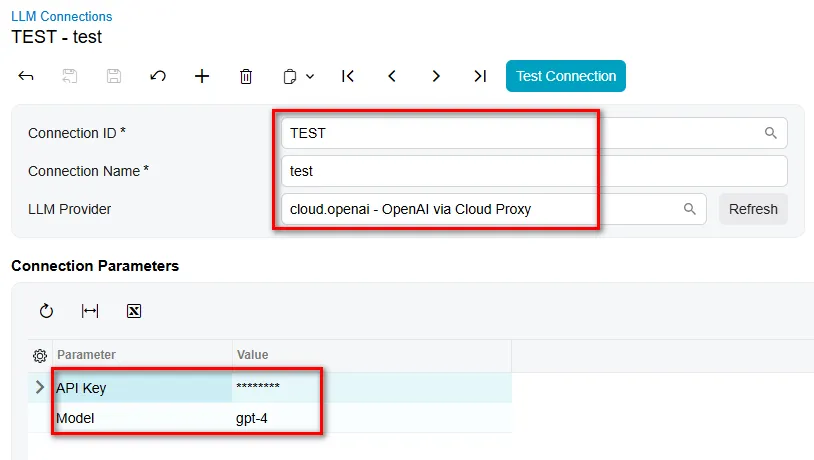
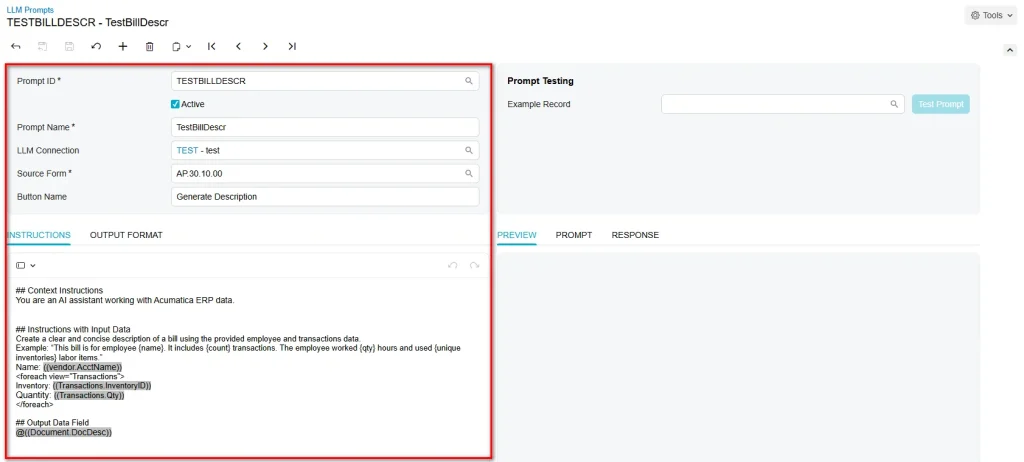
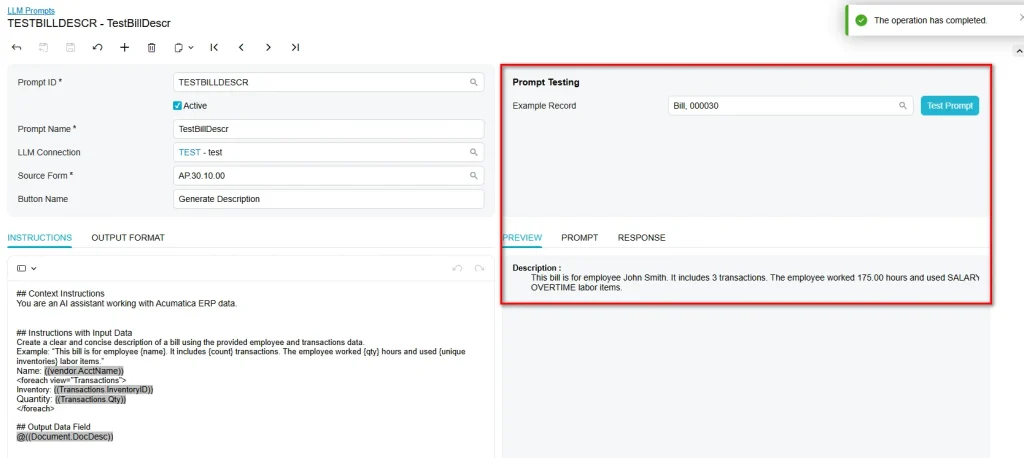
At its core, AI Studio connects your Acumatica instance to external Large Language Model (LLM) providers and lets you build AI-powered automations on specific screens — all without writing code. Important prerequisite: AI Studio requires Modern UI to be enabled on your instance.
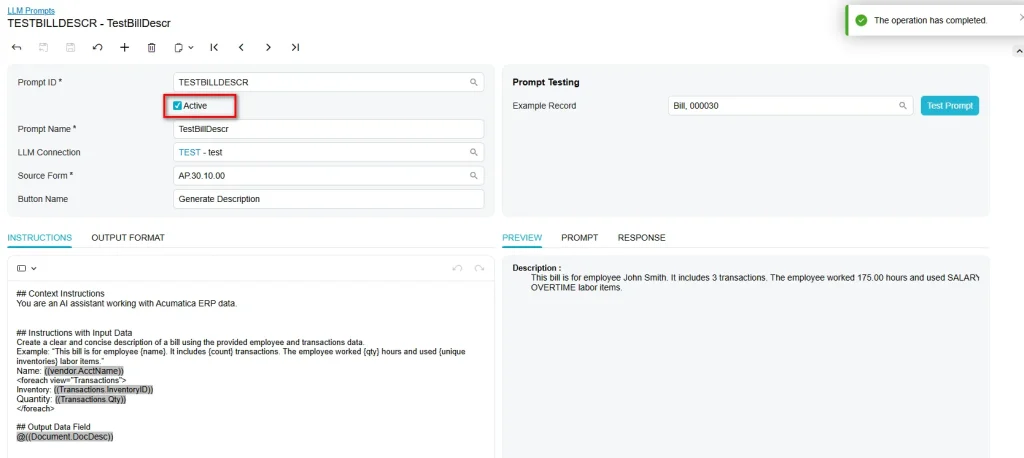
AI Studio was available at no cost during its Experimental phase in 2025 R2. With 2026 R1, AI Studio is now generally available as a full release on Select, Prime, and Enterprise tiers (not Essentials). Acumatica indicated that AI Studio would carry a licensing cost with its full release — contact your Acumatica representative for current pricing details. Customers also pay separately for their chosen LLM provider.
The AI Assistant is one of the most significant additions in 2026 R1. It allows users to ask plain-language questions directly within Acumatica and receive answers as text, charts, or tables. As of 2026 R1, the AI Assistant is available in early access, with broader availability planned for later in 2026.
For partners and VARs, the AI Assistant is a strong selling point in competitive deals. Prospects now expect natural-language interfaces in their business software, and this feature positions Acumatica as the modern, AI-forward ERP platform.
Anomaly Detection was introduced in 2024 R2 and has been progressively built out through 2025 R2 and 2026 R1. It analyzes numeric fields in Generic Inquiries to identify unusual patterns, data errors, process exceptions, and outliers. Starting with 2026 R1, the feature has been renamed from “Detection of Numeric Anomalies in Generic Inquiries” to simply “Anomaly Detection,” and GL Anomaly Detection functionality has been merged into it.
Anomaly detection is especially useful in construction, where it flags unusual cost patterns and invoice discrepancies; distribution, where it surfaces margin outliers; and manufacturing, where it picks up data inconsistencies in production costing. Field service organisations can use it to catch irregular billing patterns or equipment cost anomalies before they turn into bigger problems.

Sensitive data such as account numbers and pricing can now be blocked from AI processing. When AI tools are in use, masked fields are prevented from leaving the Acumatica instance. This directly addresses the data security concerns that come up in every AI implementation conversation.
Acumatica can now generate summaries of opportunities and support cases based on recent activity. Summaries cover customer sentiment, key details, and suggested next steps — giving sales and support teams an instant read without scrolling through full record histories.
A new tracking view shows token counts, prompt volumes, and LLM connection activity. Administrators can monitor costs and usage patterns as AI adoption grows across the organization.
Security and compliance guidelines for AI prompts can be written once and stored centrally. Developers and automation builders can pull these into their workflows rather than rewriting them for every prompt — ensuring consistent governance across all AI automations.
At Summit 2026, Acumatica previewed an AI Cross-Sell Assistant built to help sales teams identify additional opportunities based on customer purchase history & behaviour data. It’s a distribution-focused feature and a strong indicator of how Acumatica is embedding AI into industry-specific workflows. The tool was showcased as part of the 2026 R1 roadmap, and wider availability is expected as AI Studio capabilities continue to improve.
Understanding the architecture matters for partners planning AI implementations:
All AI interactions flow through Acumatica’s AI Service Gateway, which handles provisioning, licensing enforcement, governance, security (including prompt injection prevention), and telemetry. This means AI isn’t a side-channel — it’s governed within the same platform infrastructure as the rest of the ERP.
Acumatica does not host or broker AI models. Customers connect to their chosen provider (Anthropic, OpenAI, Azure, Bedrock) via API keys. All requests flow through the Acumatica Secure Cloud proxy — the ERP sends the prompt to this proxy, which forwards it to the selected LLM provider and returns the response. Acumatica does not access, store, or broker any data exchanged between the customer and the provider. No customer data is used to train Acumatica’s models. This architecture gives customers control over their data while ensuring secure, encrypted transmission.
Acumatica is also developing internal AI services — fine-tuned LLMs tailored to Acumatica-specific data, pretrained ML models for common ERP operations, and a globally shared RAG (Retrieval-Augmented Generation) vector database. These power features, like the AI Assistant and Anomaly Detection, do not require external LLM connections.
The AI landscape in Acumatica is maturing fast. Here’s what partners should be thinking about:

Sprinterra is an Acumatica ISV and Development Service Provider with deep platform expertise and hands-on AI implementation experience. Here’s how we support partners and customers on their AI journey:
We help teams configure AI Studio on their Acumatica modules: setting up LLM connections, designing and testing prompts, and deploying automations on specific screens. Since AI Studio is a low-code/no-code framework, once we configure and validate the initial workflows, your team can maintain and extend them independently.
For complex use cases — like field service scenarios where an incident on equipment should trigger AI-suggested parts orders and technician assignments based on history — we design and build end-to-end AI workflows. This includes mapping the business logic, selecting the right approach (AI Studio automation vs. custom API integration), building it, and validating against real data.
For anything beyond what AI Studio handles natively — multi-record analysis, cross-module intelligence, or connecting to external data sources — we build custom integrations using LLM APIs (Claude, OpenAI) connected to Acumatica’s REST API.
Sprinterra is actively developing a suite of AI agents purpose-built for the Acumatica ecosystem. Drawing on our broader AI services, these are specialized tools that go beyond what the standard platform offers, designed to solve specific operational challenges that partners and customers face.
One of the agents currently in development is a User Behavior Analysis Agent. It captures actual user activity traces from Acumatica instances (screen navigation, commands, timing — no PII) over a 2–4 week period, then runs the data through a multi-layer analysis engine. The output includes usage heatmaps, workflow inference maps, user persona profiles, and performance baselines. Originally designed for our Turnkey Upgrade service (to know exactly what to test post-upgrade), this intelligence is equally valuable for partners and customers looking to understand how their Acumatica environment is actually being used.
As we expand our AI agent portfolio, each agent will follow the same philosophy: deeply integrated with Acumatica’s data model, practically focused on real operational problems, and designed to produce actionable deliverables rather than generic outputs.
Acumatica’s AI roadmap is clear. Build intelligence into every layer of the platform, keep it practical and configurable, and grant customers control of their data. Between AI Studio, the AI Assistant, Anomaly Detection, and the expanding list of industry-specific AI features, the foundation is solid, and the capabilities are real.
The competitive edge now belongs to partners and customers who move from awareness to actual implementation. The tools are there. The question is how quickly you put them to work.
Get the latest insights on exponential technologies delivered straight to you
We use cookies to improve your experience on our site. By using our site, you consent to cookies.
Manage your cookie preferences below:
Essential cookies enable basic functions and are necessary for the proper function of the website.
Google reCAPTCHA helps protect websites from spam and abuse by verifying user interactions through challenges.
Google Tag Manager simplifies the management of marketing tags on your website without code changes.
Statistics cookies collect information anonymously. This information helps us understand how visitors use our website.
Google Analytics is a powerful tool that tracks and analyzes website traffic for informed marketing decisions.
Service URL: policies.google.com (opens in a new window)
Clarity is a web analytics service that tracks and reports website traffic.
Service URL: clarity.microsoft.com (opens in a new window)
Marketing cookies are used to follow visitors to websites. The intention is to show ads that are relevant and engaging to the individual user.
LinkedIn Insight is a web analytics service that tracks and reports website traffic.
Service URL: www.linkedin.com (opens in a new window)
You can find more information in our Cookie Policy and Privacy Policy.
